
Chimney Draft Problems Apartment: Fix Smoke Backdraft & Poor Draw in Manhattan
Chimney draft problems in an apartment occur when the flue fails to pull combustion gases and smoke up and out of the building instead pushing them back into living spaces, neighboring units, or common hallways. In Manhattan’s dense, high-rise residential stock, a drafting failure is not just an annoyance; it is a carbon monoxide and fire risk that can affect every tenant on a shared flue stack. If your apartment fireplace smokes into the room when you light it, if neighbors complain of smoke odors, or if your building’s flue has never been properly evaluated after a renovation, a professional chimney draft diagnosis is the first step toward a safe, legal, and usable fireplace.
At Chimney Manhattan, we specialize exclusively in New York City chimneys the pre-war co-ops on the Upper West Side, the converted loft buildings in SoHo, the landmarked brownstones in Harlem, and every stack in between. Draft problems in multi-story apartment buildings follow patterns we see every season, and we know exactly where to look.
Why Manhattan Apartments Are Especially Prone to Drafting Failures
The physics of chimney draft depend on temperature differential warm flue gases rise when the air inside the flue is warmer than the air outside. In Manhattan apartment buildings, several structural and environmental factors routinely upset that balance:
- Stack effect in tall buildings. In winter, modern high-rise apartment towers create powerful internal air pressure gradients. Cold air floods lower floors through every gap it can find including open fireplaces while warm air escapes at the top. A ground-floor or mid-rise apartment fireplace can experience negative pressure strong enough to reverse chimney draw entirely, sending smoke into the room.
- Shared flue stacks. Many pre-war Manhattan buildings run multiple fireplace flues through a single masonry chimney chase. When one apartment’s fireplace is inactive and its damper leaks, or when a gas appliance has been abandoned but its liner left open, that column of cold air depressurizes the entire shared system.
- Mechanical ventilation overpressure. Building-wide HVAC upgrades, exhaust fans in renovated kitchens, and tight replacement windows can make an apartment unit so negatively pressurized that the fireplace becomes the path of least resistance for makeup air flowing inward rather than exhausting outward.
- Blocked or deteriorated flue liners. Decades of use in NYC’s sooty air, combined with building vibration from subway lines below street level, accelerates liner cracking and spalling. Even a partial blockage dramatically reduces draft velocity.
- Height mismatch after rooftop work. Roof terraces added HVAC equipment, and parapet modifications all common in Manhattan gut renovations can obstruct the chimney termination or reduce the height above the roofline below the NFPA 211 minimum, creating a chronic downdraft condition.
Come autumn when Manhattan’s first cold snaps arrive and residents light their fireplaces for the first time in months we get a surge of calls about exactly these issues. Smoke filling a living room, soot deposits on mantels, or that persistent “fireplace smell” in the hallway. Most of these problems have clear, fixable causes. The key is accurate diagnosis before any repair is attempted.
Our Step-by-Step Approach to Diagnosing Your Apartment’s Draft Problem
We do not guess. Every chimney draft evaluation for a Manhattan apartment follows a structured diagnostic sequence so that the repair we recommend is the repair you actually need.
Step 1 — Pre-Visit Building Research
Before our technician arrives, we review any available building records, DOB filings, or prior inspection reports you can provide. For landmarked buildings, we cross-reference known construction eras so we arrive prepared for the specific masonry and liner types common to your building’s decade of construction.
Step 2 — Pressurization Assessment
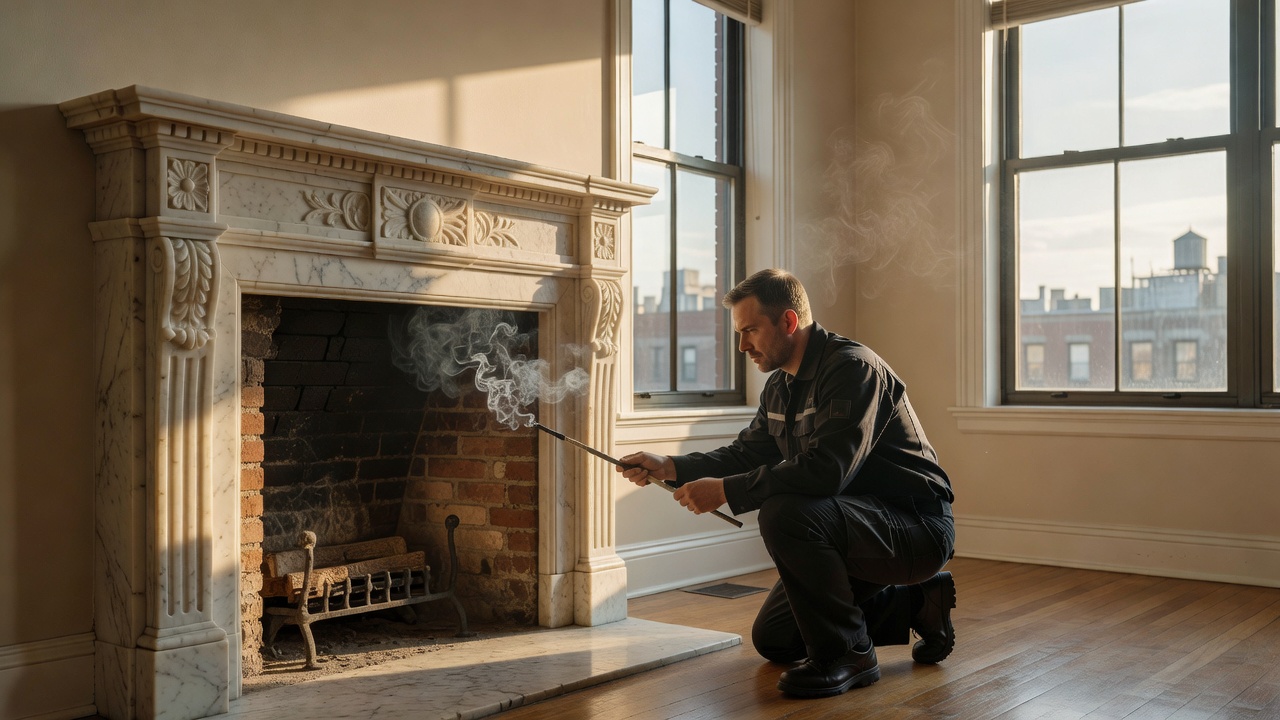
We assess the apartment’s pressure relative to the building hallway and exterior. This involves a simple door-blower test and observation of draft direction at the firebox opening with a smoke pencil. This single step tells us whether the problem is structural (the flue itself) or mechanical (building air pressure).
Step 3 — Full Visual and Camera Inspection of the Flue
Using a high-definition Level II inspection camera, we document every inch of the flue liner from the firebox throat to the chimney cap. We look for liner cracks, mortar joint failure, creosote accumulation, debris blockages (birds’ nests are common in Manhattan spring seasons), and evidence of past water intrusion. For buildings with shared flues, we inspect the dividing wythe condition where accessible.
Step 4 — Termination and Rooftop Evaluation
With building management permission, we access the roof to measure the chimney height above the roofline and surrounding obstructions. NFPA 211 requires the chimney to extend at least 2 feet above any part of the building within 10 feet of the chimney and at least 3 feet above the point of exit through the roof. Many Manhattan rooftop modifications have inadvertently violated these clearances.
Step 5 — Written Findings and Repair Proposal
You receive a written report with photographs, a clear explanation of every finding, and a prioritized repair plan. We distinguish between safety-critical repairs (open liner breaches, severe creosote, missing caps) and performance improvements (flue height extensions, top-sealing dampers). No pressure, no upselling — just a clear picture of what your chimney needs.
What the Draft Diagnostic and Repair Service Includes
- Apartment pressurization and airflow assessment
- Smoke pencil draft-direction test at firebox opening
- Level II CCTV camera inspection of full flue length
- Rooftop termination height and obstruction measurement
- Damper operation and seal evaluation
- Creosote and debris accumulation assessment
- Shared-flue condition review (where building access permits)
- Written photographic inspection report
- Specific repair recommendations with itemized pricing
- Coordination with building management or co-op board as needed
If repairs are approved on the same visit such as a chimney cleaning to remove a blockage or the installation of a top-selling damper to eliminate cold-air backdraft we complete them the same day whenever materials permit. Most draft-problem repairs in Manhattan apartments are resolved in one or two visits.
Serving the Buildings and Neighborhoods That Define Manhattan’s Residential Landscape
We have worked inside the chimneys of Beaux-Arts co-ops on Central Park West, 1920s brick walkups in Washington Heights, cast-iron-era buildings in Tribeca, and postwar high-rises in Murray Hill. Manhattan chimneys are not interchangeable a flue in a 14-story pre-war building on Riverside Drive behaves very differently from one in a four-story brownstone on West 130th Street, and our technicians understand those differences in practice, not just in theory.
We are fully licensed and insured to work in New York City, and our work complies with NYC Fire Code Chapter 28 and NFPA 211 standards. When a repair requires a DOB filing or coordination with your building’s managing agent, we have done it before and we guide you through the process without confusion.
We do not subcontract. The technician who performs your inspection is the same professional who writes your report and executes your repairs. That continuity matters when the problem is subtle and chimney draft problems in Manhattan apartments often are.
Frequently Asked Questions About Apartment Chimney Draft Problems in Manhattan
My building is a pre-war co-op with eight apartments sharing one chimney stack. If my neighbor’s flue is the source of the draft problem, am I responsible for the fix?
Liability and cost-sharing for shared chimney repairs in Manhattan co-ops and condos typically follows the building’s proprietary lease or offering plan, and the co-op board is usually the responsible party for common elements like the shared masonry chase. However, individual apartment owners are generally responsible for their own flue liner and damper. We provide documentation that clearly identifies which part of the system is failing your unit’s components or the shared structure so your board and managing agent have the evidence they need to assign repairs correctly. We have written many such reports for Manhattan co-op boards.
Can installing a top-sealing damper actually solve a chronic backdraft problem in a Manhattan apartment?
Yes — frequently. A top-sealing damper replaces the traditional throat damper and seals the flue at the chimney cap when the fireplace is not in use. This eliminates the column of cold outdoor air sitting in the flue, which is one of the most common causes of backdraft on first ignition in Manhattan apartments. It also prevents the negative-pressure draw that the stack effect creates in tall buildings from pulling cold air down an unsealed flue. Top-sealing dampers are a cost-effective first intervention when the flue liner and termination height are otherwise sound but we always confirm the root cause before recommending them.
I’ve been told my apartment’s fireplace “just needs to warm up” before it drafts properly. Is that actually true, or is it masking a real problem?
It can be partly true a cold flue does draft poorly until the air inside it warms above the ambient temperature, which is why priming the flue with a rolled newspaper before lighting is a standard technique. But if your fireplace routinely smokes into the room for more than a few minutes at each use, or if the problem has worsened over time, “it just needs to warm up” is almost certainly masking something else: a partial blockage, a cracked liner letting in cold air from a neighboring flue, an undersized firebox-to-flue ratio, or a termination obstruction. In our experience with Manhattan apartments, a healthy flue that is merely cold responds quickly to priming. One that smokes persistently needs a proper inspection.
Stop Letting Smoke Back into Your Home — Schedule Your Diagnosis Today
A chimney draft problem in a Manhattan apartment will not resolve itself, and it will not improve as winter deepens. Every time you use a fireplace that backdrafts, you are introducing carbon monoxide risk, depositing creosote in spaces you cannot see, and potentially sending smoke into neighboring units which is a building code and liability issue, not just a comfort issue.
Chimney Manhattan’s technicians are ready to diagnose your apartment’s draft problem, give you a straight answer about what is causing it, and repair it correctly the first time. We serve all of Manhattan, and we are familiar with the buildings, the buildings’ boards, and the buildings’ chimneys.
Call us or use our online booking form to schedule your chimney draft inspection. We offer appointments six days a week, including Saturday, and we work with building management schedules for access coordination. Do not wait until the first cold weekend of the season draft diagnostics book up fast in October and November in Manhattan.
Chimney Manhattan Draft Problems Diagnosed Right, Repaired Right, the First Time.