
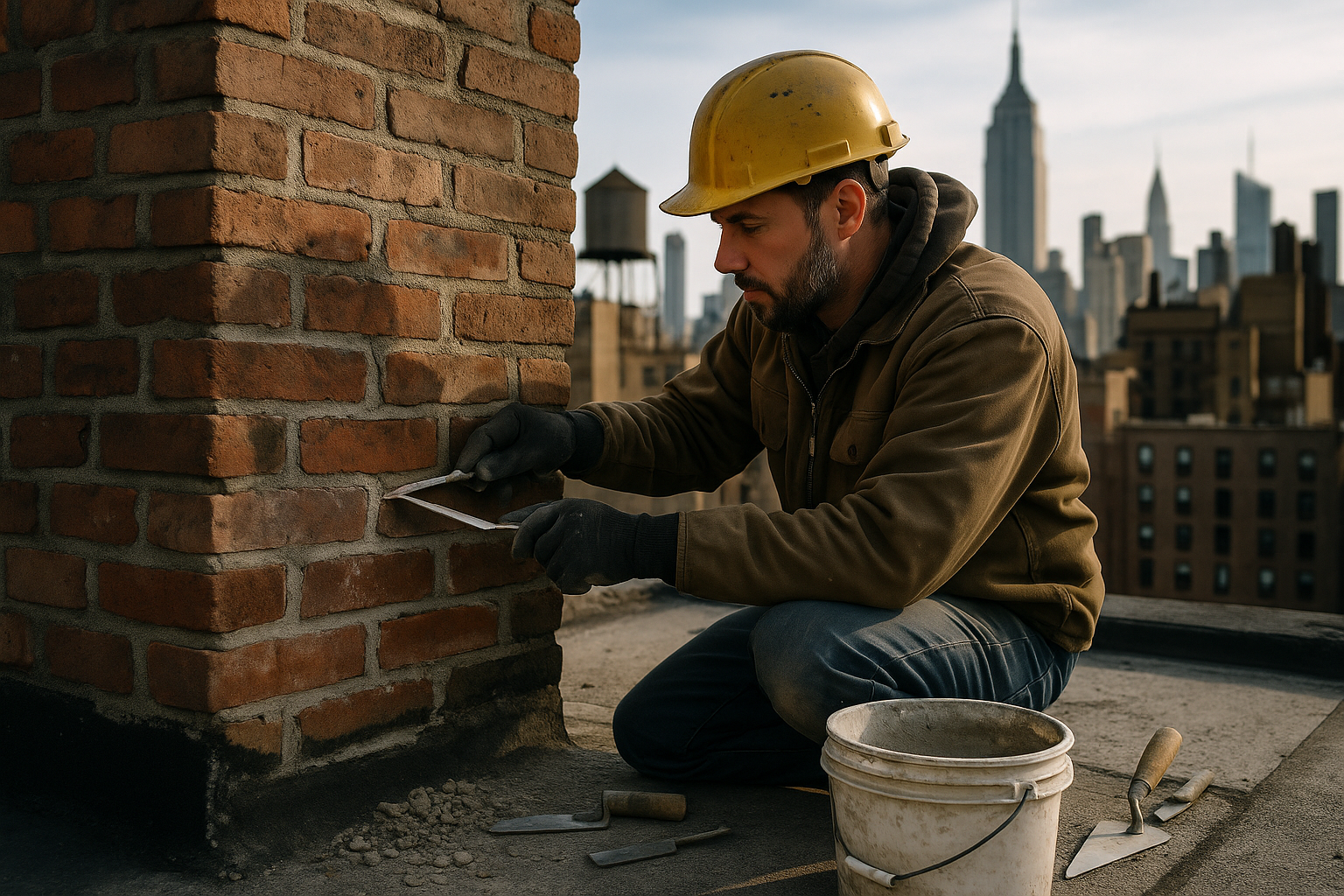
Masonry And Brick Repair in Manhattan
If you are searching for reliable Masonry and Brick Repair in Manhattan, Chimney Manhattan is your locally based team serving every borough neighborhood from Inwood to the Financial District. We open with a blunt truth: Manhattan winters are merciless on brick and mortar, and waiting until spring to deal with the damage almost always costs you more. Freeze-thaw cycles that slam the island between November and March pry open hairline cracks, heave mortar joints, and push spalled brick faces off chimneys that looked perfectly fine last summer. Our crews are on the ground year-round, and we start booking masonry repair calls the moment the first hard freeze of the season breaks.
Why Manhattan’s Winters Are the Real Villain for Brick Chimneys
Manhattan sits on a narrow island with water on three sides the Hudson River to the west, the East River and Harlem River to the north and east, and New York Harbor to the south. That waterfront exposure means moisture is always in the air, and pre-war brownstone chimneys in neighborhoods like Hamilton Heights, Morningside Heights, and Washington Heights absorb that moisture constantly. When temperatures drop below 32°F, that trapped water expands roughly nine percent in volume. Do that repeatedly across 90-plus freeze-thaw cycles per winter and you have a mortar joint that crumbles like stale bread.
High-rise wind loading is another factor unique to Manhattan. Buildings in Midtown and the Upper East Side channel wind through canyon corridors at speeds that accelerate moisture penetration into any existing crack. A two-millimeter fissure in a chimney crown on a Central Park West co-op becomes a water highway within a single season. We have repaired chimneys on pre-war buildings throughout Carnegie Hill and on converted loft buildings in West Chelsea where the combination of altitude, wind exposure, and aged lime mortar created catastrophic joint deterioration in just two winters.
The Repair Methods We Use and Why They Match Manhattan’s Aged Building Stock
Manhattan’s building stock skews old. The vast majority of chimneys on residential and mixed-use structures were built between 1880 and 1940, using soft lime-based mortars that are genuinely different from the Portland cement products available today. Using a modern high-strength Portland mix to repoint a 1910 brownstone chimney on West 113th Street is one of the most common and most damaging mistakes a non-specialist contractor makes. Portland cement is harder than the surrounding brick and forces stress into the brick face instead of the sacrificial mortar joint, causing spalling that destroys irreplaceable historic brick.
Our masons identify the original mortar composition before mixing a single batch of repair material. For pre-war chimneys in Harlem, the Upper West Side, Gramercy, and Chelsea, we typically formulate a Type N or custom lime-based mortar blend that matches the original joint hardness and breathability. For newer construction in Battery Park City or Kip’s Bay, we adjust accordingly. Tuckpointing the process of grinding out deteriorated mortar to a depth of at least three-quarters of an inch and packing in fresh matched mortar is executed by hand on Manhattan jobs because the close quarters of most Manhattan rooftops and rear yards make mechanical grinders impractical and hazardous.
Beyond repointing, our masonry repair services include:
- Spalled and cracked brick replacement using period-appropriate salvage brick where available
- Chimney crown repair and full crown replacement in cast-in-place hydraulic cement
- Brick corbeling repair on decorative chimney stacks
- Efflorescence treatment and water-repellent sealing using vapor-permeable sealants
- Lintel and firebox brick repair
- Parapet wall masonry stabilization adjacent to chimney structures
- Post-inspection emergency stabilization following NYC DOB facade or fire department directives
Freeze-Thaw Season Is When the Damage Becomes Visible — Here Is What to Watch For
Every spring, building superintendents and homeowners across Manhattan notice the same things after the last hard freeze: white chalky streaks running down brick faces (efflorescence), chunks of mortar in the gutters or on rooftop surfaces, brick faces that flake off in thin sheets (spalling), and dark water stains on interior walls near the chimney breast. These are not cosmetic issues. They are structural warnings. A chimney stack that loses enough mortar cohesion can shift, lean, or in extreme cases shed masonry onto the sidewalk below a liability nightmare in a borough where pedestrian density on streets like Broadway, Columbus Avenue, or Amsterdam Avenue is among the highest in the country.
If your building received a FISP (Facade Inspection Safety Program) report citing chimney masonry deficiencies, or if your building’s board or super has flagged loose mortar, do not delay scheduling an inspection. We work alongside building managers across Lenox Hill, Turtle Bay, Sutton Place, and the Upper East Side regularly, and we understand the documentation and timeline requirements that co-op and condo boards often need before authorizing repair work.
Serving the Full Length of Manhattan — Neighborhoods We Work In Every Week
Chimney Manhattan is based in New York City and operates throughout the entire borough of Manhattan. Our service area includes but is not limited to:
- Upper Manhattan: Inwood, Washington Heights, Hamilton Heights, Harlem (East, West, and Central), Manhattanville, Morningside Heights
- Upper West Side and Upper East Side: Riverside Drive corridors, Central Park West, Carnegie Hill, Yorkville, Lenox Hill
- Midtown: Hell’s Kitchen, Clinton, Murray Hill, Turtle Bay, Kip’s Bay, Sutton Place, Midtown East and West
- Downtown and Lower Manhattan: Chelsea, Flatiron, Gramercy, the East Village, the West Village, SoHo, Tribeca, the Financial District, Battery Park City
- Roosevelt Island and Governors Island (seasonal access)
We do not subcontract our masonry work to third parties. Every crew member who lands on your roof or enters your mechanical space is a Chimney Manhattan employee, trained specifically in urban high-rise masonry conditions.
Frequently Asked Questions About Masonry and Brick Repair in Manhattan
My co-op board received a NYC DOB violation related to our chimney’s masonry — how quickly can you respond and what documentation do you provide?
We prioritize DOB-related calls and can typically complete an initial inspection within two to four business days of your call. After inspection we provide a written scope of work and cost estimate suitable for board presentation. Upon completion of repairs, we supply a signed certificate of completion and photographic documentation that your building’s architect or expediter can use when filing a Certificate of Correction with the Department of Buildings. We are familiar with the FISP cycle paperwork requirements and can coordinate directly with your building’s designated qualified exterior wall inspector if needed.
How do I know whether my brownstone chimney on the Upper West Side needs repointing or full brick replacement?
Repointing addresses deteriorated mortar joints while the surrounding brick remains structurally sound. It is the right solution when brick faces are intact and the mortar has simply worn back or crumbled. Full brick replacement becomes necessary when the brick itself has spalled more than a third of its face depth, when freeze-thaw damage has caused the brick to delaminate in layers, or when a brick has cracked through its body rather than just the mortar joint. During our inspection we probe joints with a hand pick and assess spalling depth with calipers we do not guess, and we do not recommend full replacement when repointing will do the job. Pre-war Upper West Side brownstones almost always benefit from selective repointing combined with targeted brick replacement on the worst-affected courses rather than a wholesale teardown and rebuild of the chimney stack.
Is late fall or winter a bad time to schedule masonry repair on a Manhattan chimney?
It depends on the severity of the damage and the specific repair type. Emergency stabilization for example, securing a leaning chimney stack or sealing a cracked crown that is actively admitting water should never wait for warm weather. For full repointing jobs, fresh mortar requires temperatures above 40°F during application and for at least 48 hours after, so we monitor forecasts carefully and may schedule work around cold snaps. We use cold-weather admixtures and insulated curing blankets where conditions permit to extend our working season well into November and resume in early March. If your chimney is deteriorating now, call us for an inspection even in the cold months we will tell you honestly what can be safely done immediately and what should be scheduled for the first warm window.
Schedule Your Masonry Inspection Before the Next Freeze Cycle Widens the Damage
Masonry deterioration in Manhattan does not pause while you figure out next steps. Every rainstorm and every freeze-thaw cycle that passes without repair makes the problem larger and the repair bill bigger. Chimney Manhattan offers thorough on-site inspections for masonry and brick repair across all Manhattan neighborhoods, delivered by masons who know the specific aging brick types, mortar compositions, and wind-exposure conditions that define this borough.
Call us today or submit a service request through our website to book your inspection. We will assess your chimney’s masonry condition honestly, provide a clear written estimate, and explain every repair option in plain language no pressure, no upselling, no work that is not genuinely needed. Manhattan chimneys are our specialty, and we want yours standing solid for another hundred years.
Related from Chimney Manhattan: Masonry And Brick Repair in Manhattan · Chimney Repair NYC — Expert Masonry & Structural Repairs in Manhat