
Essential Gas Fireplace Inspection Manhattan NYC: 2026 Guide for Gramercy Park Residents
Most Gramercy Park homeowners call us thinking a gas fireplace inspection Manhattan NYC means someone flips the unit on, watches the flames for a minute, and hands them a certificate. That assumption has led to some genuinely dangerous situations in the buildings we service along Irving Place, East 20th Street, and the co-ops tucked around Stuyvesant Square. The reality of what a proper inspection involves and what it does not involve is worth understanding before you book anyone.
Last winter, a homeowner in a landmarked brownstone on East 19th Street near Third Avenue called us after their building’s management company had “inspected” their gas fireplace as part of a routine visit. The technician had looked at the pilot flame, checked the remote receiver, and left in under ten minutes. Six weeks later, our team found a deteriorating flex connector behind the firebox panel, a blocked secondary air vent, and a draft hood that had been incorrectly repositioned during a prior renovation. None of it had been caught. The unit had been running all December.
That scenario is more common than it should be. Here is what a legitimate inspection actually looks like, and where the misconceptions tend to cluster.
The Flame Check Is Not the Inspection
The most persistent misunderstanding we encounter especially among buyers in Gramercy Park’s pre-war co-ops is that verifying the burner ignites is the beginning and end of the job. It is not. Ignition tells you the gas valve opened and the spark worked. It tells you almost nothing about the condition of the venting system, the integrity of the heat exchanger, the state of the ceramic logs and media, or whether combustion gases are staying where they are supposed to stay.
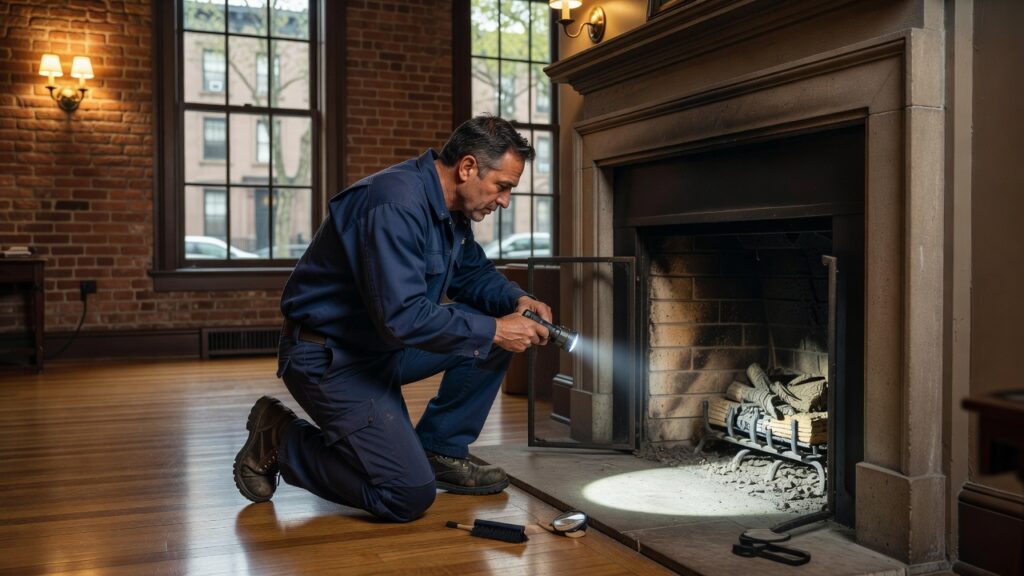
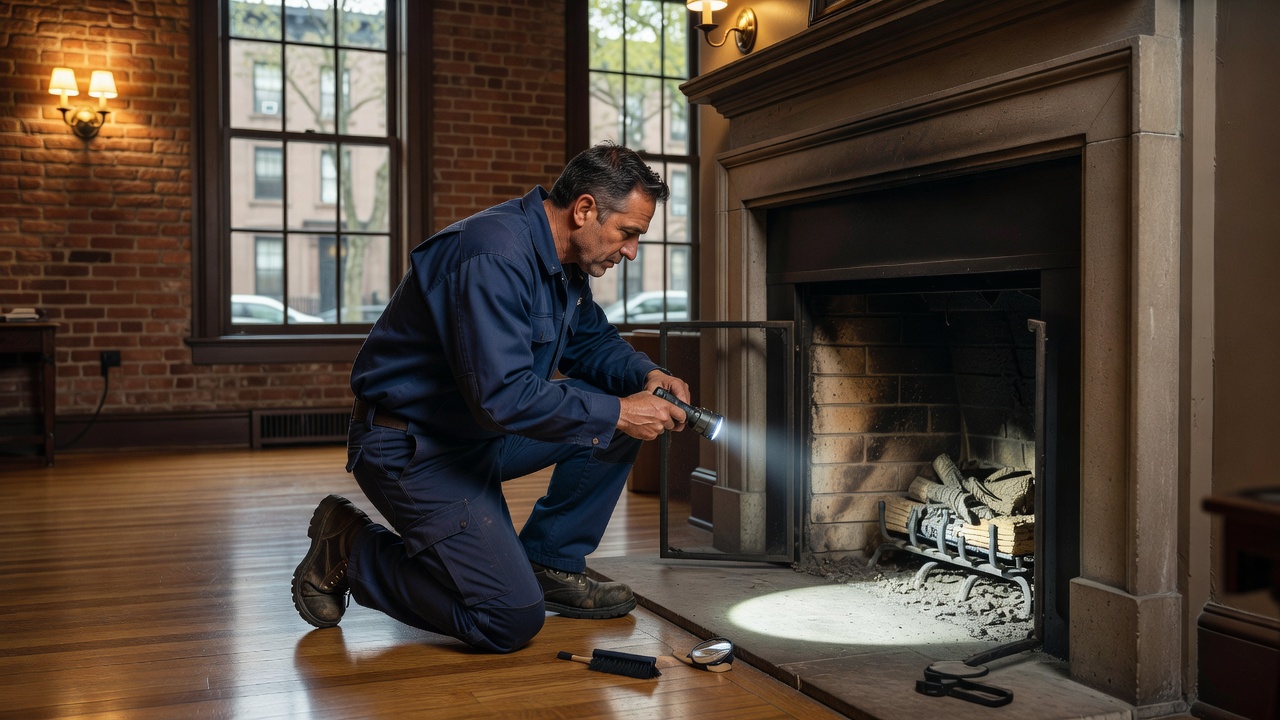
A proper gas fireplace inspection involves a systematic review of the firebox interior, the burner orifice, the pilot assembly, the thermocouple or thermopile, the gas line connections visible within the unit, the venting path from the firebox collar through whatever chase or liner carries it out of the building, and the termination cap at the roof. In a Manhattan high-rise or a five-story townhouse, that vent run can be long and complex, and it is where problems quietly develop between inspections.
What “Venting” Actually Means for a Gas Appliance
Gas fireplaces in this city come in several configurations natural draft, direct vent, power vent, and vent-free. Each has a different inspection profile. We find that homeowners in Chelsea and Murray Hill frequently assume their direct-vent unit is inherently safe because it draws combustion air from outside and exhausts directly through a sealed system. That is true by design. It is not true if the coaxial vent pipe has a loose collar joint or if the exterior termination cap is blocked by debris or a bird nest, which we see at least a dozen times per heating season across the buildings we serve.
For natural-draft units, particularly older ones in Gramercy Park’s pre-1950 buildings that share masonry flues with other appliances, the inspection has to include a visual assessment of the shared liner and an evaluation of draft conditions. According to NFPA 211, chimneys, fireplaces, and vents should be inspected at least once per year and cleaned as necessary to reduce fire and carbon monoxide risks. That standard applies to gas appliances just as it does to wood-burning ones a fact many homeowners do not know until we tell them.
The Carbon Monoxide Question Gets Oversimplified
People hear “gas fireplace” and assume carbon monoxide is only a concern with wood fires. That is wrong, and it is the kind of wrong that has real consequences. Any appliance burning natural gas produces combustion byproducts including CO, and if those byproducts are not venting completely to the outside, they migrate into the living space. The U.S. Fire Administration reports that heating fires account for approximately 15 percent of all residential structure fires in the United States, with chimney-related failures including venting failures on gas systems being a leading cause.
In dense residential buildings like the ones lining Lexington Avenue between 20th and 23rd Streets, a venting problem in one unit can affect adjacent units depending on how the building’s flue system is shared or configured. This is why our inspection process always includes a spillage test and, where we have any doubt, a CO reading at the firebox opening during operation. A technician who skips that step is not performing a complete inspection, regardless of what the paperwork says.
Annual Inspections Are Not Optional for Infrequent Users
We hear this one regularly from homeowners on Park Avenue South who use their gas fireplace four or five times a year: they assume low usage means the unit needs less attention. The opposite is often true. A unit that sits idle most of the year is more likely to have spider webs or insect debris in the pilot tubing, a corroded thermocouple, a stiff gas valve, or a compromised gasket around the firebox door. Low-use units also tend to be the ones where minor issues go unnoticed the longest, because the owners are not paying close attention.
The Chimney Safety Institute of America recommends that homeowners hire only CSIA-certified chimney sweeps, noting that certified professionals are trained to identify structural hazards, code violations, and venting problems that untrained workers may miss. We hold that certification, and we bring that same standard of review to gas appliances that we bring to wood-burning systems. The inspection credential matters because the diagnostic process requires actual training, not just familiarity with how to light a pilot.
What the Inspection Does Not Cover and Why That Matters
Homeowners sometimes expect that a gas fireplace inspection will include cleaning the interior glass, servicing the remote receiver, or diagnosing why the flame pattern looks a certain way. Some of those things may be addressed during the visit, but they are distinct from the safety inspection itself. We are clear with every customer including those in Washington Heights and Inwood where we do a fair amount of work in converted multifamily buildings about what the inspection scope covers before we arrive. Surprises in either direction, finding more problems than expected or fewer, are better managed when the baseline expectations are honest.
If the inspection identifies a problem a cracked firebox panel, a failing flex line, a blocked vent we explain exactly what we found, show photographs when possible, and lay out the repair options with straightforward pricing. We do not perform unnecessary work on gas systems. The liability exposure alone would be reason enough to stay honest, but more to the point, our reputation in this city is built on the trust of the people who live here.
Frequently Asked Questions
How long does a gas fireplace inspection in Manhattan typically take?
For a standard gas fireplace inspection Manhattan NYC appointment, our technicians typically spend between 60 and 90 minutes on-site. That time covers the firebox interior, burner components, pilot and ignition system, gas line connections accessible within the unit, the full vent path, termination cap condition, and an operational spillage test. Buildings with shared masonry flues or complex vent runs common in Gramercy Park’s older co-ops may take longer. We never rush the process because the point of the inspection is to find what is actually there, not to move to the next job.
Does NYC require an annual inspection for gas fireplaces in residential buildings?
New York City’s Fire Code under Title 29 requires that chimneys and flue systems in multi-family dwellings be inspected and maintained in compliance with NFPA 211. For gas appliances that share a flue or vent into a common masonry chimney, that standard applies directly. Even in single-family townhouses and owner-occupied co-op units, NFPA 211 specifies annual inspection as the minimum standard. We advise every Gramercy Park client to treat annual inspection as a baseline, not a suggestion both because the code points that direction and because the cost of catching a problem early is always lower than the cost of repairing the damage after the fact.
What does a gas fireplace inspection cost in Manhattan in 2026?
In 2026, a standard gas fireplace inspection in Manhattan typically ranges from $175 to $275 for a straightforward residential unit with accessible venting. Buildings with complex vent runs, shared liner systems, or units that require rooftop access to inspect the termination point may fall in a higher range. We provide a clear scope and price before we start. Any repairs identified during the inspection are quoted separately and require your approval before any work begins. There are no hidden fees, and we do not manufacture problems to justify additional charges.
Schedule Your Gramercy Park Gas Fireplace Inspection
Our team serves Gramercy Park and the surrounding neighborhoods from Hell’s Kitchen and Chelsea to the Upper East Side and Morningside Heights with the same level of care we would bring to our own buildings. If your gas fireplace has not been professionally inspected in the past twelve months, or if you are buying or selling a unit and need a documented assessment, contact Chimney Manhattan to schedule your inspection. We are reachable by phone and through the contact form at chimneymanhhattan.com, and we are happy to discuss what the job involves before you commit to anything.
Related from Chimney Manhattan: Masonry And Brick Repair in Manhattan · Fireplace Damper Repair in Manhattan · Smart Pre-Winter Chimney Inspection Manhattan