
Essential Home Manhattan Chimney Guide: 2026 Guide for Manhattan Residents
Every home Manhattan sits in is different a pre-war co-op on Riverside Drive behaves nothing like a converted brownstone on West 128th Street in Harlem or a townhouse in Gramercy Park. But when our phones ring, the problems we hear about fall into a recognizable set of patterns. Chimneys that draft poorly. Fireplaces that smell like a campfire in July. Flues that haven’t been looked at since the previous tenant. And behind many of those calls is the same underlying issue: the wrong contractor handled the system at some point, and now a homeowner is dealing with the aftermath.
This post is not a general chimney 101. It is specifically about how we diagnose the most common chimney problems we find in Manhattan homes and just as important how to make sure the next technician you let through your door is someone who can actually fix them.
A Call From West 87th Street That Said It All
Last winter, a co-op owner on West 87th Street on the Upper West Side reached out after a contractor she found through a flyer had cleaned her fireplace and declared it “good to go.” Two weeks later, she had a smoky living room every time she tried to light a fire. When our team arrived, we found the damper had been forced open during the previous cleaning and bent out of its seat. The smoke chamber above it had no parging the smooth mortar coat that directs combustion gases upward and the flue liner had a crack that had clearly been there for at least one heating season. None of it had been noted in the other contractor’s report, because there was no report. Just a receipt.
That scenario plays out more often than it should, from Washington Heights down to Tribeca. Here is what real chimney diagnosis looks like, and what questions protect you before work begins.
The Problems We Actually Find and How We Think Through Them
Smoke Backing into the Room
Symptoms are obvious: the room fills with smoke when you light a fire. The diagnostic reasoning, though, involves ruling out several causes in sequence. First we check for a closed or partially stuck damper. Then we assess draft in many Manhattan high-rises and older brownstones, stack effect from the building itself can reverse the natural draft in a flue. We measure the flue cross-section relative to the firebox opening. An undersized flue relative to the firebox is a code and physics problem, not a cleaning problem. We also check whether the chimney terminates below the roof line or near a parapet that creates a wind shadow. Each cause has a different fix. A bent damper gets replaced. An undersized flue may require a liner installation or a smoke guard. A wind-shadow problem sometimes needs a chimney cap with a directional cowl.
Can this be prevented? Yes. An annual inspection catches damper wear before it becomes a failure, and a proper liner assessment at purchase tells you what you are working with before you light your first fire.
Creosote Buildup Beyond Stage One
Most homeowners assume chimney cleaning is a single, uniform service. It is not. The Chimney Safety Institute of America (CSIA) states that creosote a byproduct of wood combustion is the leading cause of chimney fires, and that third-degree glazed creosote is extremely difficult to remove and highly flammable. We find Stage 2 and Stage 3 creosote in a meaningful percentage of Manhattan homes that have been burning wood in gas-converted fireplaces or that switched back to wood burning after years of inactivity. Stage 3 requires chemical treatment before mechanical removal is even possible. A contractor who quotes a standard sweep price and does not assess creosote level before starting work is not doing the job correctly.
Cracked or Deteriorated Flue Liner
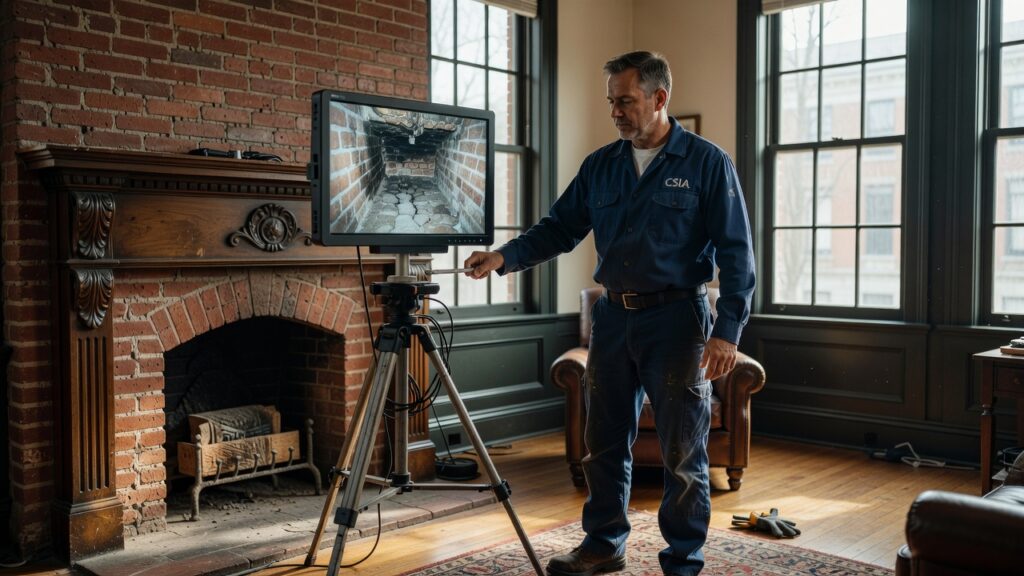
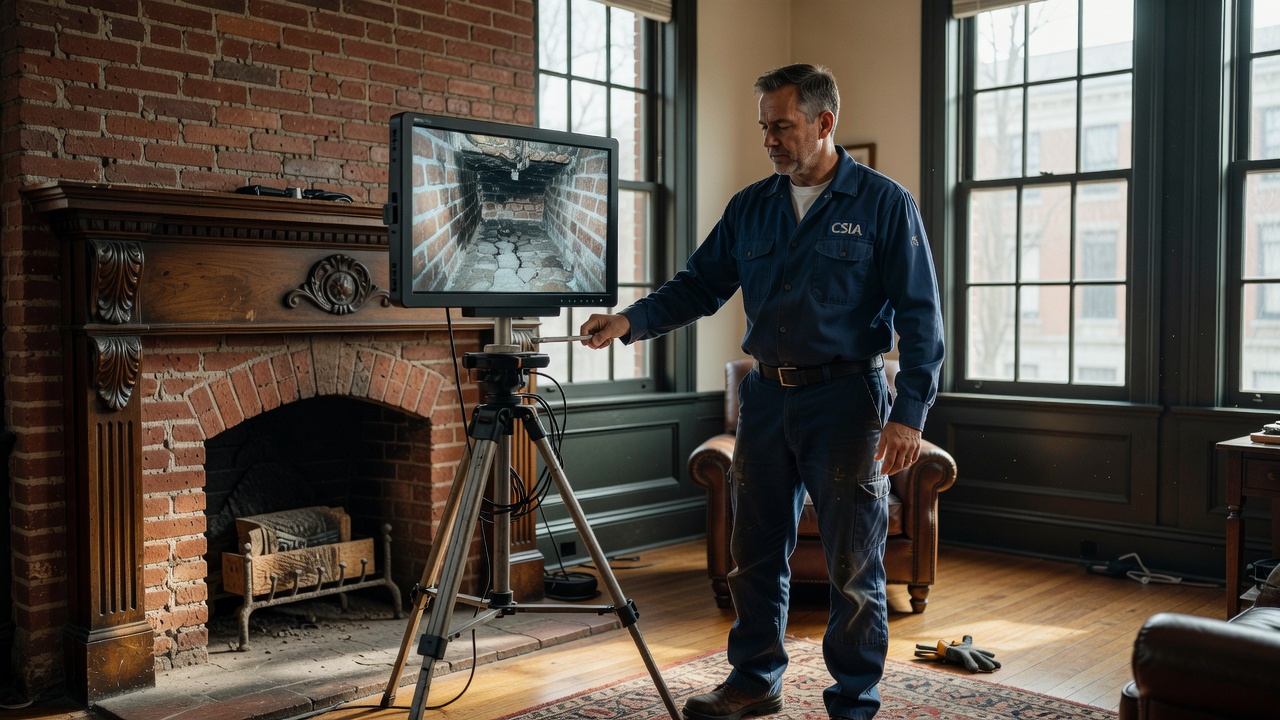
This is the problem most likely to have serious consequences and the one most commonly missed by unqualified contractors. Cracks in a clay tile liner allow combustion gases including carbon monoxide to migrate into living spaces. In a dense building like a Hell’s Kitchen pre-war with shared chimney chases, a cracked liner in one unit can affect neighbors. We diagnose this with a Level 2 inspection using a camera system. According to NFPA 211, a Level 2 inspection is required any time a home changes ownership, after any chimney fire, or after any event that could have affected the chimney structure. A camera inspection is not optional it is the standard. If a contractor tells you about a visual check from the firebox opening is sufficient, that is a red flag.
Spalling Masonry and Failed Mortar Joints
Manhattan’s freeze-thaw cycles are hard on brick and mortar, especially on chimney crowns and exposed exterior sections above rooflines. We see heavy spalling on chimneys in Inwood and Washington Heights where older buildings have not had tuckpointing work in decades. Water gets into micro-cracks, freezes, and widens the damage every winter. Left alone, this becomes a structural problem. The fix is tuckpointing deteriorated joints, replacing the crown if it is cracked, and applying a vapor-permeable waterproofing sealer. The prevention piece is a proper cap and crown inspection every two to three years in older masonry buildings.
Damper Failure and Seasonal Heat Loss
A damper that does not seal properly wastes heat year-round and can allow outside air, moisture, and even animals into the flue. In Murray Hill and Midtown East apartments with older throat dampers, we commonly find warped metal and missing gaskets. A top-mounted damper is often the right upgrade it seals from the top of the flue, keeps rain and animals out, and typically costs between $300 and $500 installed in Manhattan as of 2026. The diagnostic sign is a persistent cold draft from the firebox even when the damper handle is in the closed position.
Poor Venting After a Gas Conversion
Thousands of Manhattan fireplaces were converted from wood to gas over the past few decades. Many were done without proper liner relining. Gas appliances produce cooler, more corrosive exhaust than wood fires, and an unlined masonry flue is not rated for that type of venting. The U.S. Fire Administration reports that heating fires account for approximately 15 percent of all residential structure fires, with chimney-related failures being a leading cause. When we inspect a gas-converted fireplace in a Chelsea or Morningside Heights brownstone, we look specifically at whether the liner is rated for gas, whether the appliance is properly sized for the flue, and whether the venting terminates correctly above the roofline.
What a Qualified Contractor Actually Looks Like
The CSIA recommends hiring only CSIA-certified chimney sweeps, noting that certified professionals are trained to identify structural hazards, code violations, and venting problems that untrained workers may miss. In New York City, the NYC Fire Code under Title 29 also requires that chimneys and flue systems in multi-family dwellings be inspected and maintained to comply with NFPA 211 standards. That is a legal obligation, not a suggestion.
Before any contractor touches your chimney, ask for their CSIA certification number and verify it at csia.org. Ask whether they carry general liability and workers’ compensation insurance get the certificates, not just a verbal yes. Ask what level of inspection they are performing and whether it includes a camera. Ask for a written report with photographs. If they hesitate on any of those questions, find someone else.
Red flags we hear about regularly: contractors who quote over the phone without asking about the system, who offer dramatically low prices for full service, who do not provide written estimates, or who recommend immediate and expensive repairs without showing you documentation of why. A legitimate sweep will show you the camera footage and explain what they found before recommending any repair.
Talk to Our Team Before the Next Heating Season
We work throughout Manhattan from Inwood and Washington Heights in the north to Tribeca in the south in brownstones, co-ops, townhouses, and historic buildings. If your last chimney service left you with more questions than answers, or if your fireplace is showing any of the symptoms above, reach out to Chimney Manhattan. We do honest inspections, provide written reports with photos, and only recommend work that the documentation supports. Call us or use the contact form on chimneymanhhattan.com to schedule a 2026 inspection.
How do I know if a chimney contractor is actually qualified to work on my Manhattan home?
Look for CSIA certification, which you can verify directly at csia.org. Ask for proof of liability insurance and workers’ compensation before work starts. In New York City, chimney work in multi-family buildings must comply with NFPA 211 and the NYC Fire Code. A qualified contractor will provide a written inspection report with photographs not just a verbal assessment.
What is a Level 2 chimney inspection and do I need one?
A Level 2 inspection, as defined by NFPA 211, includes a camera scan of the interior flue and is required whenever a home changes ownership, after a chimney fire, or after any event that may have affected the chimney structure. If you are buying a Manhattan co-op or brownstone with a fireplace, a Level 2 inspection is the standard a basic visual check from the firebox opening is not sufficient to assess liner condition.
My Manhattan apartment has a gas fireplace. Does the chimney still need to be inspected?
Yes. Gas fireplaces produce cooler, more corrosive exhaust than wood, and many Manhattan buildings that converted from wood to gas were not properly relined at the time of conversion. An unlined or improperly lined masonry flue used for gas venting is a carbon monoxide risk. The NFPA 211 annual inspection standard applies to gas-burning appliances just as it does to wood-burning systems. If your fireplace has not been inspected since the gas conversion, schedule one before the 2026 heating season.
Related from Chimney Manhattan: Professional Chimney Cleaning Services in Manhattan, NYC · Chimney Repair NYC — Expert Masonry & Structural Repairs in Manhat · Chimney Draft Problems Apartment